Investing in Standards! : From Idea to Impact.

As an entrepreneur or manufacturer, it is important to know that when you invest in the purchase of a standard you invest in more than compliance. The investment made is in the trust of your customers, in safer products, stronger businesses and in opportunities to compete beyond the shores of Saint Lucia. Many people, business owners and consumers, however, are unaware that standards are not simply created behind shut doors and handed out for businesses to follow. They are developed through a collaborative process which welcomes the input of industry experts, business owners, consumers and many other relevant stakeholders. From the inception of the need for a standard being identified to the point of publishing and implementation there are opportunities for you to get involved and contribute your knowledge and experience. Whether you are an entrepreneur, professional, consumer or member of the public there is potential for your perspective to help shape the standards that influence products, services and practices across Saint Lucia.
Why should I care about standards development if I am not a standards expert?
The standards developed at the Saint Lucia Bureau of Standards are designed for the use and benefit of the business owners, manufactures and consumers of Saint Lucia and they affect your businesses and your daily life. While most of our standards are voluntary, there are compulsory standards which persons must adhere to as enforced by law. Your participation and experience within industries as business operators or consumers provide you with the capacity to influence future requirements outlined in standards when being developed. Despite a standards expert being versed in the process of developing and adopting standards, they are not behind the counters at your businesses, or in the workshops or warehouses, and so the reference they draw from is limited. Stronger standards are developed when they reflect local realities and can be based on actual industry expertise, making your experience extremely valuable to the work of the standards experts at the SLBS.
A Walk Through the Process
The standards development process generally comprises of seven stages. The SLBS encourages the involvement of industry experts and consumers from the identification of the need for a change.
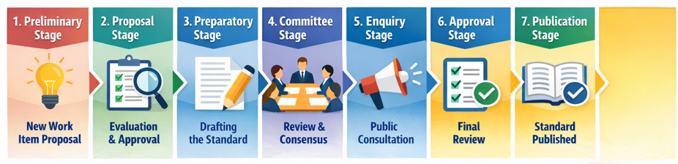
Let’s walk through how.
Preliminary Stage:
Take for example Joey, who is in the business of sanitation or waste collection. During his daily pick ups Joey has observed that while some business establishments separate and clearly label their potentially hazardous waste there are quite a few establishments who do not. Overtime, he becomes concerned that these inconsistent practices could pose significant risk to his colleagues, himself or the wider public. He does his research and finds that there is no widely recognized national guidance to enforce consistent practices for waste storage and handling. This is an opportunity for Joey to work with the SLBS to turn his ideas on proper waste disposal into a proposal to resolve this issue. By simply contacting the Standards Development Department via telephone or email and filling out a New Item Proposal, the document that gets the process going.
Proposal Stage: Assessing the Need
A standards development officer would then review Joey’s proposal just as they would with all NWIP documents submitted. If there is sufficient justification for the development of a standard and there is stakeholder interest the proposal will be approved. A Technical Committee is then established, bringing together representatives like Joey from waste management companies, environmental agencies, businesses, and other relevant stakeholders.
Preparatory Stage: Developing the Draft Standard
The technical committee beings developing a working draft. Members contribute their expertise, share their practical experiences and review existing international guidance to ensure that the proposed standard reflects global best practices while working realistically within local realities.
Committee Stage: Building Consensus
The draft standard would undergo several rounds of discussions and revision. Committee members examine the proposed requirements, identify potential challenges and work toward agreement on the content. This collaborative process helps ensure that the standard is practical and achievable.
Enquiry Stage: Inviting Public Participation
Once a draft national standard is confirmed it is circulated for public comment. Businesses, industry professionals and members of the public are invited to review the document and provide feedback. Individuals who work directly within industry, in this case in waste management, can offer valuable insights that assist in strengthening the standard and ensuring it addresses real- world conditions.
Approval Stage: The Final Review
After the disposal of all comments received, the technical committee reaches consensus on a final draft of the standard and verifies that all procedures have been followed before recommending the standard for approval.
Publication Stage: Making the Standard Available
After being approved the standard would then be published and made available to the public who could access via our website or visit the bureau for assistance in attaining the standards.
This is a clear example of how any member of the public within any industry can identify a problem and become part of a process that helps to contribute to change. Stakeholders are encouraged to be empowered, not only to comply but also participate in developing and supporting standards as a contribution to personal and national progress. As a member of any industry, the ability to contribute your voice to the process enables you to decide on guidelines based on your experience and insight. Remember whether you’re a business owner, professional, consumer or community member, your observations and expertise can help shape standards that contribute to the development of a better Saint Lucia. For more information on how you can get involved call: (758) 453 0049/456 0546.